
Your Energy Is Not “Too Much.” It’s Just Uncontrollable
Let’s set the scene.
You walk into a room with ideas, momentum, and solutions.
You’re three steps ahead.
You speak up, move fast, follow through.
And instead of meeting you at that level, someone pulls you aside and says it:
“You’re a lot.”
“Can you tone it down?”
“Just don’t come on so strong.”
You weren’t yelling.
You weren’t being rude.
You were showing up.
But apparently, showing up fully is too much for people who are used to half-effort in a polite voice.
Let’s be clear:
You are not “too much.”
You are just not easily managed.
And for some people, that’s the real problem.
Step One: Understand the Label
When someone calls your energy “too much,” what they’re usually trying to say is:
- You can’t be controlled easily
- You don’t need constant validation
- You trust yourself more than you rely on them
- You take up space in a room without asking first
And that makes people uncomfortable. Not because you’re wrong—but because you’re uncontainable.
Uncontainable energy threatens people who build their value on being the most in-the-know, the most relied on, or the most emotionally centered.
Your presence feels like a disruption to their positioning.
So they reframe it as a problem.
Step Two: Catch the Micro-Comments
People rarely say, “You intimidate me because you move with clarity and don’t need me to co-sign your thinking.”
They’ll say things like:
- “You’re just super high energy.”
- “You always have so many thoughts.”
- “You should let other people have space too.”
- “You don’t need to drive everything.”
These sound neutral. They’re not.
They’re soft attempts to regulate your presence.
In other words: “Stop being so effective—it makes me feel behind.”
Step Three: You Don’t Need to Shrink
Here’s what high-energy women are often told to do:
- Wait your turn
- Don’t speak first
- Use softer language
- Stop “jumping ahead”
- Ask for consensus before offering a solution
None of that advice is actually about improvement.
It’s about containment.
You don’t need to shrink your energy to make other people feel okay.
You just need to use your energy intentionally.
And that starts with owning the fact that it’s not a flaw. It’s an asset.
Step Four: Use Your Energy Strategically
Power isn’t about volume. It’s about direction.
If you have high energy, you probably:
- Finish tasks quickly
- Think in big-picture patterns
- Push meetings forward when they stall
- Offer ideas before people are ready to receive them
- Trigger other people’s insecurity without meaning to
Your job isn’t to dilute that. It’s to aim it.
Here’s how:
1. Ask before offering a solution—but only once
You don’t have to apologize for thinking fast. But you can give people a chance to catch up.
Try:
“I have a thought if you’re open to it.”
Then drop it clearly. No qualifiers. No disclaimers.
2. Practice short silences
Before you respond, pause.
This isn’t about being performative. It’s about keeping your energy from being read as chaotic when it’s just fast.
Silence gives people time to think. It also shows you’re not just reacting—you’re choosing.
3. Save your drive for moments that matter
Not every conversation needs your full engine.
But the ones that do? Don’t hold back. Don’t shrink. Don’t water it down so someone else feels less threatened.
Let them adjust.
Step Five: Call It When You See It
If someone keeps trying to manage your energy under the label of “feedback,” you’re allowed to name it.
Try:
- “I’ve noticed this keeps coming up—what specifically feels like ‘too much’ to you?”
- “I’m happy to adjust if it’s about outcomes, but not just tone.”
- “My energy is part of how I lead. If it’s throwing things off, let’s talk about specifics.”
Ask for the data. Ask for the results. Don’t accept coded language as actionable critique.
The Truth About Being “Too Much”
You’re not too much.
You’re just not afraid of your own power.
And that power feels unmanageable to people who have only ever been rewarded for keeping things calm, small, and predictable.
You don’t have to trade your natural momentum for someone else’s comfort.
You don’t have to slow down to prove you’re collaborative.
You don’t have to apologize for having presence.
You’re not out of control. You’re just not under theirs.
Say It With Confidence
Next time someone implies you should tone it down, you can smile and say:
“This is how I lead. I trust it.”
Or
“Thanks for the feedback. I’ll keep doing what works.”
And keep it moving.
Want more practical tools for handling coded criticism and performance management politics?
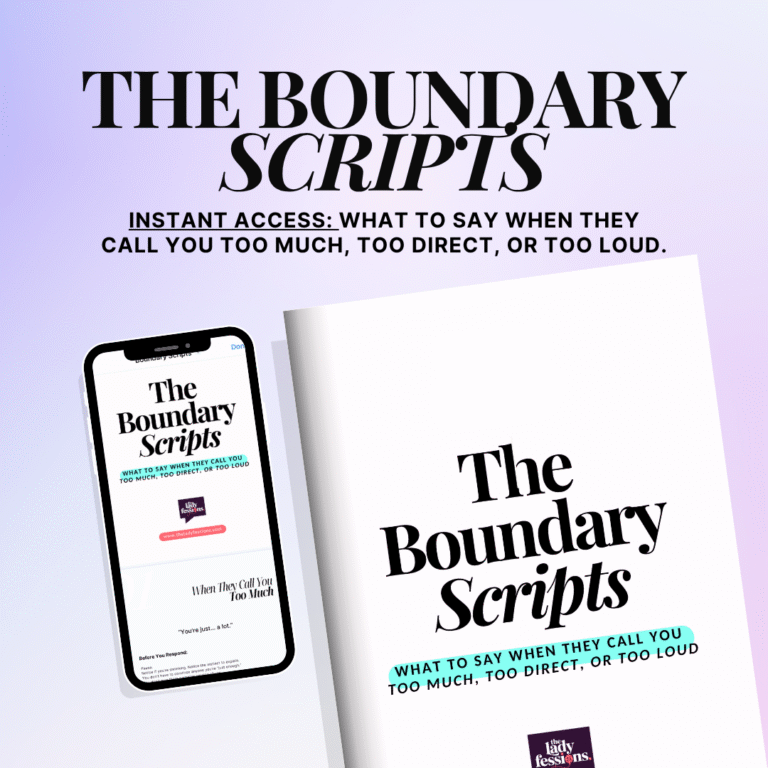
Grab the free download: Boundary Scripts — What to Say When You’re Labeled “Too Much” for Simply Doing Your Job.